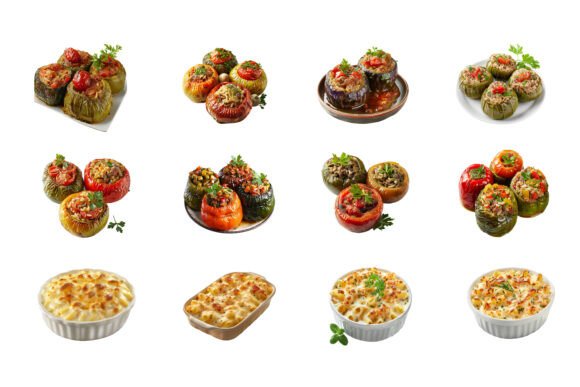
A Guide to Set of Delicious Stuffed Bell Peppers Illustration Collections
For designers, illustrators, and content creators, sourcing high-quality, versatile vector artwork is a fundamental part of many projects. The Set of Delicious Stuffed Bell Peppers represents a specific category within broader illustration sets, focusing on detailed, editable depictions of this popular dish. Such collections are typically packaged as downloadable files containing AI and EPS formats alongside JPG previews. Understanding the characteristics, applications, and limitations of these resources is crucial for making an informed selection that aligns with your project requirements and workflow.
What This Illustration Set Entails
A Set of Delicious Stuffed Bell Peppers is a digital illustration collection centered on imagery of bell peppers prepared as stuffed meals. The core offering is a vector file, usually in Adobe Illustrator (AI) or Encapsulated PostScript (EPS) format, which allows for infinite scaling without loss of quality. A complimentary JPG file is often included for quick preview or use in contexts where vector editing is not needed. The set is designed for cross-platform compatibility, meaning it can be opened and edited on both Mac and Windows operating systems using common graphic software. The promise of such sets lies in their internal organization—a neat file and layer structure that facilitates easy editing, color changes, and modifications to individual elements like the pepper, filling, or accompanying design details.
Potential Benefits and Applications
The primary benefit of a specialized set like this is time efficiency. Creating a detailed, consistent illustration of a stuffed bell pepper from scratch requires significant skill and time. A pre-made, high-quality vector set provides a ready-made asset. Its vector nature means it is suitable for diverse applications, from large-scale print media like menus or cookbook layouts to web graphics, mobile app icons, or infographic elements. The ease of editing colors and modifying the icon allows for seamless branding integration, enabling the artwork to match specific color schemes or stylistic needs across different projects. For creators focused on food-related content, culinary branding, or educational materials, having a professionally designed set can elevate the visual consistency and detail of their work.
Key Considerations and Tradeoffs
While the benefits are clear, several considerations must be weighed. First, the term "perfection in details and consistency" is subjective. Evaluating the actual quality of the line work, shading, and artistic style against your project's standards is essential; preview images should be scrutinized closely. Second, although advertised as easily editable, the practical ease depends entirely on the user's proficiency with vector editing software like Adobe Illustrator. A neat layer structure is helpful, but complex vector files can still be challenging for beginners to manipulate extensively.
Another tradeoff involves specificity. A Set of Delicious Stuffed Bell Peppers is highly niche. It serves a very particular theme. If your needs extend to a broader range of food illustrations—other vegetables, dishes, or culinary tools—this single set may be insufficient, potentially requiring you to purchase additional collections. This contrasts with more general "food icon" packs that offer wider variety but possibly less detail on individual items.
Situations Where This Set is a Strong Fit
This illustration collection is a particularly strong fit for certain scenarios. It aligns well with projects requiring repeated, branded use of a stuffed pepper image. For instance, a food blog specializing in pepper recipes, a catering company with a signature stuffed pepper dish, or an educational health pamphlet focusing on vegetable-based meals could use this asset across multiple platforms consistently. Designers working on a single, specific project like a restaurant menu or a packaged food label featuring this item would also find it highly efficient. The set is also suitable for creators who value editorial control and need to adjust the artwork to fit evolving design layouts or color palettes without starting from zero.
When Alternatives Might Be Worth Considering
In other situations, alternative solutions may be more appropriate. If your project demands a wide array of food illustrations, a broader "food vector pack" encompassing multiple fruits, vegetables, and dishes might offer better value and cohesion than piecing together multiple hyper-specific sets. For users with minimal vector editing skills or projects requiring only small-scale, static use (like a single blog post image), a high-resolution royalty-free photograph of a stuffed bell pepper might be simpler and more realistic. Furthermore, if budget is a primary constraint and the project scope is limited, exploring free vector resources from reputable public domain sites, though often less meticulously organized, could be a viable alternative.
Practical Decision-Making Insights
To determine if a Set of Delicious Stuffed Bell Peppers aligns with your goals, conduct a practical needs assessment. First, clearly define the scope and frequency of use. Is this a one-time need or a recurring asset? Second, audit your technical capability and available software. Can you comfortably edit AI or EPS files? Third, compare the visual style of the set with your existing or planned design aesthetics. Does the illustration's detail level and artistic approach harmonize with your project? Finally, consider the total cost of visual assets for your project. If this set fills a critical, repeated need, it may justify its place. If it only addresses a minor, one-off requirement, a simpler or more general alternative might be more resource-efficient.
The decision to utilize a specialized illustration set like the Set of Delicious Stuffed Bell Peppers ultimately hinges on a match between its inherent qualities—editability, detail, and niche focus—and the specific practical demands of your creative work. By objectively evaluating your requirements for quality, application range, technical skill, and project budget, you can make a selection that genuinely supports your workflow and enhances your final visual outputs without unnecessary compromise or expenditure.