Privacy Icons: A Versatile Icon Set for Modern Digital Projects
In our visually driven digital landscape, clear and effective communication often hinges on the smallest details. Among these, icons play a crucial role. They guide users, convey complex ideas instantly, and establish a cohesive visual language. For projects centered on data, security, or user rights, finding the right symbols can be a unique challenge. This is where a specialized set like Privacy Icons comes into focus.
What Is Privacy Icons?
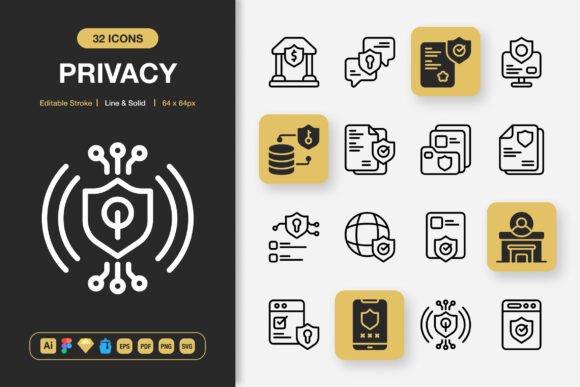
Privacy Icons is a high-quality collection of minimalist icons designed to represent concepts related to privacy, security, data, and digital interaction. It transcends being just a graphic asset; it’s a practical toolkit. The set is built for versatility, offering both line and solid styles with an editable stroke, meaning you can adjust the weight and appearance to match your project’s aesthetic precisely. The promise of this set isn't merely in its theme, but in its comprehensive delivery: it provides easy drag-and-drop files in multiple formats and sizes, ready for virtually any application.
Why Different Audiences Might Care
The value of a resource like Privacy Icons isn't universal—it shifts based on who is using it and what they aim to achieve. A blogger might see it as a way to enhance reader comprehension, while a mobile app developer considers it essential for intuitive user interface design. The common thread is the need for professional, clear visuals without the overhead of creating them from scratch.
For a freelancer or small business owner, time and cost are paramount. Investing in a well-packaged set saves hours of design work or the expense of hiring a graphic designer for custom icons. The included source files (Adobe Illustrator, Figma, Sketch) mean they can make minor adjustments themselves or hand the files off to a collaborator seamlessly.
An educator or publisher working on a book, infographic, or presentation material might prioritize clarity and scalability. Having icons in EPS, PDF, and multiple PNG sizes (from 32px to 512px) ensures the graphics remain sharp whether printed on a poster or displayed on a classroom screen. The minimalist design avoids visual clutter, keeping the educational message front and center.
Evaluating the Set Through Different Lenses
How one evaluates Privacy Icons depends heavily on their experience and immediate goals.
The Beginner’s Perspective: Ease and Learning
If you're new to design or digital projects, your priority is likely ease of use and reliability. A set that includes a straightforward Readme.txt file, Iconjar files for organization, and simple PNGs with transparency can be a gentle entry point. You don’t need to open complex software; you can start by dragging PNGs into your website builder or social media template. This hands-on experience also has a learning value, introducing you to standard file formats and how vector graphics (SVG) differ from raster (PNG).
The Professional’s Criteria: Flexibility and Quality
For UI/UX designers, developers, or agency professionals, the assessment is more technical. Quality is judged by the cleanliness of the vector paths, the consistency of the icon family, and the availability of the source files. The flexibility to edit the stroke in Illustrator or Figma is non-negotiable for fitting the icons into an existing brand system. The inclusion of SVG files is critical for modern web development, ensuring icons scale perfectly without performance hits. For them, the long-term usefulness and commercial value—being able to use these in client projects legally and efficiently—are key decision factors.
The Creator’s Focus: Creativity and Application
Marketers, content creators, and hobbyists often operate across multiple platforms. They need assets that work for a flyer, a YouTube channel banner, an Instagram post, and an infographic—all within the same campaign. The breadth of included formats and sizes directly supports this cross-media creativity. The minimalist design is a benefit here; it ensures the icons don’t compete with other visual elements but rather complement them. A practical example: a hobbyist running a niche blog about internet security can use these icons to create a custom graphic for each blog post category, elevating the site's professionalism without deep design skills.
Aligning the Toolkit With Your Project Needs
Deciding if Privacy Icons matches your needs involves a simple alignment check. Consider your project's type, scope, and your own skill level.
Are you building a mobile app that handles user data? The icon set’s thematic relevance and SVG format for app interfaces make it a strong candidate. Is your project a one-time printed flyer for a community event on digital rights? The high-resolution PNG and PDF files for print might be exactly what you need.
The set’s structure acknowledges that not everyone uses the same tools. By providing files for Adobe Illustrator, Figma, Sketch, and even Iconjar, it respects the diverse software ecosystems used by different segments of the audience. This practical approach removes a common barrier: format conversion headaches.
Identifying Your Own Priorities
Take a moment to identify what matters most for your current task. Is it speed—getting professional icons instantly? The drag-and-drop nature facilitates this. Is it presentation—ensuring your annual report looks polished and credible? The cohesive, high-quality design of the icons supports that goal. For an entrepreneur launching a new service, the icons might provide the quick visual foundation needed for a prototype or pitch deck, offering commercial value from day one.
Ultimately, a resource like Privacy Icons serves as a bridge. It connects a specific thematic need with a universal demand for quality, adaptable visual assets. Whether you are a beginner looking for a safe starting point or a seasoned professional requiring meticulous control over your design elements, the depth and construction of the package allow you to extract value at your own level. By focusing on practical delivery—real files in real formats for real projects—it moves beyond being a simple product to being a genuine project ally, capable of changing the visual output of your next website, app, book, or campaign.