A Comprehensive Evaluation of Data Backup Icon Sets for Design Projects
In the realm of digital and print design, visual communication is paramount. Icon sets serve as a fundamental toolkit, enabling designers to convey concepts quickly and effectively. A specialized collection, such as a Data Backup Icons set, provides a curated library of symbols focused on themes of data security, cloud storage, recovery, and digital preservation. Evaluating such a resource requires an understanding of its content, format, and applicability to various projects.
What Constitutes a Data Backup Icon Set?
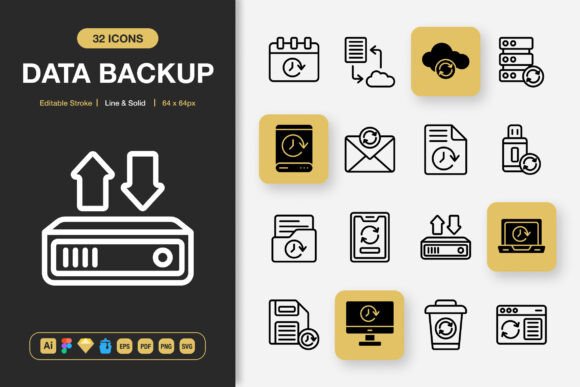
A Data Backup Icons set is a cohesive package of graphical symbols representing actions, devices, and concepts related to data backup processes. Typical icons might include representations of cloud servers, hard drives, USB sticks, folder syncing, encryption locks, restoration arrows, and warning symbols for data loss. The set described includes both line and solid styles, offering flexibility for different visual weights and contexts. The promise of high quality suggests careful attention to detail, consistent stroke weights, and clean, scalable geometry.
Core Features and File Formats
The practical value of an icon set is deeply tied to its technical delivery. A comprehensive package, as noted, includes multiple file formats to ensure compatibility across design ecosystems. Source files in Adobe Illustrator and Figma allow for deep customization, as does the inclusion of Sketch and EPS Version 10 files. Raster PNG files at specific pixel dimensions (32px to 512px) cater to immediate use in digital interfaces without scaling concerns. The SVG format is crucial for modern web development, enabling resolution-independent use. The presence of IconJar and PDF files adds to organizational and print versatility. This multi-format approach significantly reduces the friction of asset preparation.
Potential Benefits and Reasons for Interest
Designers and developers might consider a dedicated Data Backup Icons set for several objective reasons. Firstly, it ensures visual consistency. Using a singular, well-designed set across an entire project—be it a website for a cloud service, a mobile app for file management, or an infographic on cybersecurity—creates a professional and unified aesthetic. Secondly, time efficiency is a major factor. Instead of creating individual icons from scratch or searching for disparate symbols, a complete set provides a ready-made library. The editable stroke and customizable nature mean icons can be adapted to match existing brand colors or line styles without starting from zero.
Furthermore, the minimalist design approach mentioned aligns with contemporary design trends that favor clarity and simplicity. Such icons are less likely to overwhelm an interface or document and tend to be more universally recognizable. For projects targeting a broad audience, this clarity is essential.
Tradeoffs and Key Considerations
While the benefits are clear, several considerations must be weighed. A specialized set like Data Backup Icons is inherently niche. If a project requires a wide variety of icons outside the data and technology domain—such as healthcare, commerce, or travel symbols—this set alone will be insufficient. It may need to be supplemented with other libraries, complicating asset management.
The claim of "100 Customizable" icons suggests a substantial library, but the actual scope and variety within the data backup theme should be scrutinized. Does it cover modern concepts like ransomware protection or blockchain-based backup? Or is it focused on more traditional hardware symbols? The depth of the theme coverage directly impacts its usefulness for cutting-edge projects.
Another practical consideration is the skill requirement. While the icons are described as easy to drag and drop, full customization using the source Illustrator or Figma files requires familiarity with those vector editing tools. Teams or individuals without this expertise would primarily use the static PNG or SVG files, limiting the customization potential.
Situations Where This Icon Set Is a Strong Fit
This Data Backup Icons set is likely a strong, purpose-built solution for specific project types. It would be highly suitable for the user interface of software applications focused on data management, backup solutions, or cybersecurity services. Websites for these companies would also find immediate application in feature lists, dashboards, and explanatory graphics.
For educational or instructional materials, such as books, flyers, or posters explaining data safety practices, a clear and consistent icon set can greatly enhance comprehension. The included PDF and high-resolution PNG files support print materials effectively. Social media campaigns aimed at promoting data awareness could utilize these icons in posts and infographics to create a recognizable visual theme.
Projects that already embrace a minimalist design philosophy will find the style alignment particularly beneficial. The line and solid style options allow the icons to integrate seamlessly into both lightweight and bold visual layouts.
When to Consider Alternatives
Alternatives should be explored in several scenarios. If a project requires a vast, general-purpose icon library covering hundreds of categories beyond technology, a broader, more universal set (or even a subscription to a major icon service) would be more economical and practical. For projects with an extremely unique or avant-garde aesthetic, a minimalist, pre-designed set might not offer enough stylistic differentiation; custom illustration might be necessary.
Budget is also a factor. While this set offers value through its multiple formats, some designers might operate exclusively in one software environment (e.g., only Figma). In such cases, a single-format set tailored to that tool could be simpler. Furthermore, if the project scope is very small—requiring only three or four specific data icons—finding individual free or premium icons on a per-need basis might be more cost-effective than purchasing a full 100-icon set.
Practical Decision-Making Insights
To determine if a Data Backup Icons set aligns with your needs, conduct a simple audit. First, list all the icon concepts your current project requires. Map them against the likely contents of this set. If there is a high overlap, it is a good candidate. Second, review your team's design tool proficiency. If you use Illustrator, Figma, and Sketch, the multi-format support is a significant advantage. If you only use one tool, ensure the provided format for that tool is fully editable.
Consider the lifecycle of your project. Is it a one-off flyer, or a long-term software product that will evolve? For evolving products, a customizable, scalable vector set provides long-term value as features and branding change. Finally, assess your need for visual consistency versus creative uniqueness. If establishing a clear, professional thematic signal is more important than groundbreaking icon art, a specialized set like this serves that goal effectively.
In summary, a Data Backup Icons set is a specialized design resource offering efficiency, consistency, and quality within its thematic domain. Its value is maximized in technology-focused communication projects where minimalist clarity is desired. By carefully evaluating project scope, team capabilities, and stylistic goals, designers can make an objective decision on whether such a curated asset library is the right tool for their current and future projects.